
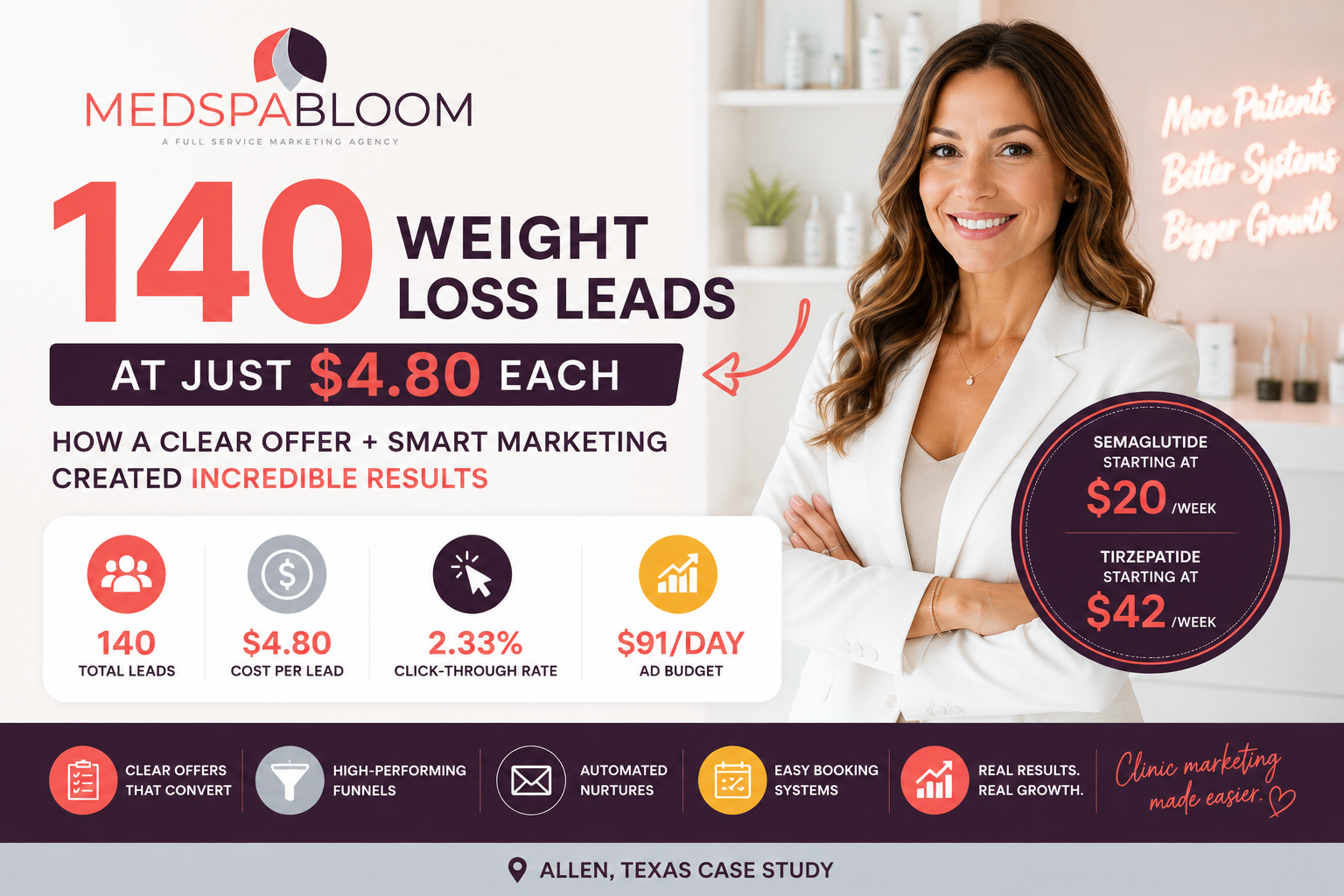
All Data is for August 2026 Ad Performance
👋Can we talk about something that makes me a little crazy?
A clinic runs ads that aren’t performing. The leads are expensive. Or worse, they’re coming in but they’re junk. So someone looks at the campaign and announces:
“We just need to increase the budget.”
Girl, no.
If something isn’t working at $50 a day, blindly throwing $100 a day at it gives you the exciting opportunity to lose money twice as fast.
That’s not a growth strategy.
So when I saw the numbers from a medical weight loss campaign we were running in Allen, Texas, I wasn’t excited just because the CPL was low. I was interested in why the numbers were so good.
Because this campaign generated:
140 medical weight loss leads.
At an average cost of… $4.80 per lead.
Yep. Four dollars and eighty cents.
And there’s a much bigger marketing lesson hiding inside those numbers.
Let’s Do Some Marketing Girl Math
Here’s what we were working with.
The clinic wanted to generate leads for its medical weight loss program, so the campaign promoted Semaglutide and Tirzepatide.
The offer was wonderfully simple:
- Semaglutide starting at $20/week.
- Tirzepatide starting at $42/week.
The campaign was running on a reported $91/day ad budget.
The result?
140 leads at $4.80 each with a 2.33% click-through rate.
Now, if you’ve been paying $30, $50, $70+ for weight loss leads, I already know what you’re thinking.
Girl, WHAT did you do?!
And this is where I’m going to disappoint anyone looking for the magical Meta Ads button.
There isn’t one.
Sorry. 😂
Before You Blame Meta, Look at Your Offer
Here’s the first thing that jumped out at me about this campaign:
The offer was ridiculously easy to understand.
The prospect didn’t have to decode it.
They didn’t have to click through three pages to figure out what was being offered.
They didn’t have to wonder what “affordable medical weight management solutions customized to your wellness journey” actually means.
Nobody asked for that.
Instead, they saw something concrete:
- Semaglutide starting at $20/week.
- Tirzepatide starting at $42/week.
That’s it.
And psychologically, that matters because one of the biggest enemies of conversion isn’t necessarily price – it’s uncertainty.
When someone sees your ad, there are already questions running through her head.
- How much is this going to cost me?
- Is this actually for someone like me?
- What’s the catch?
- What happens after I submit this form?
- Am I about to get stalked by six text messages and a receptionist named Ashley?
Every unanswered question creates a little more friction. The clearer your offer becomes, the easier the next decision becomes.
Good marketing is often less about convincing someone to do something and more about removing the reasons she hasn’t done it yet.
The Ad Didn’t Need to Convince Everyone
This is another mistake I see constantly in medical weight loss marketing.
Clinics try to put the entire consultation into the ad.
- How GLP-1s work.
- Why their providers are different.
- What their program includes.
- Why medical supervision matters.
- Their philosophy.
- Their credentials.
- Their process.
- Their favorite lunch order.
Okay, maybe not the last one – but you get my point.
Your ad doesn’t have to close the entire sale.
It just has to create enough interest for the right person to take the next step.
A specific price anchor can help someone quickly determine whether an offer feels relevant.
Instead of asking:
“Do I want medical weight loss?”
We’re helping them consider a much easier question:
“Would I explore Semaglutide starting at $20/week?”
That’s a smaller decision.
Smaller decisions create less resistance.
Less resistance can mean more response.
So Should You Offer Semaglutide for $20 a Week?
Girl. No.
Please don’t read a case study on the internet and immediately change your pricing.
That’s how we end up with 14 clinics in the same city running the same $99 special wondering why nobody is responding anymore.
The takeaway is not the price.
The takeaway is the structure of the offer.
- Specific.
- Concrete.
- Easy to understand.
- Low mental effort.
- Clear value.
That’s what I’d steal because the same offer will not perform identically in every market. Your competition, geography, pricing, reputation, creative, audience and follow-up can all change your results.
In fact, our own campaign data shows medical weight loss CPLs varying dramatically across clinics and offers.
We’ve seen campaigns generating leads in the single digits and teens—and others in the $20s, $30s, $40s and considerably higher.
So please don’t walk into Monday’s staff meeting announcing:
“The internet says weight loss leads should cost $4.80!”
Because we most certainly did not. 😂
Here’s the Part Most Marketing Case Studies Conveniently Forget
I love a $4.80 CPL.
You know what I love more? Booked appointments.
And you know what I love even more than that? Booked appointments that show up and become patients.
This is where I want clinic owners to change the way they look at marketing, because a lead isn’t a patient.
If your agency sends you a report screaming: 🎉 140 LEADS!!! 🎉
My next question is: “Great. How many booked?“
That’s part of the MedspaBloom philosophy for a reason: lead volume matters, but booking rate, show rate, nurture response and what happens farther down the patient journey matter too.
Cheap leads can become very expensive if nobody follows up with them.
And an expensive lead can become incredibly profitable if that person books, shows and becomes a long-term patient.
So CPL is one piece of the story, not the whole story.
Your Front Desk Is Part of Your Marketing
There. I said it.
Your ads can be gorgeous.
Your offer can be irresistible.
Your CPL can make every other clinic owner jealous.
But if someone submits a form at 11:07 a.m. and your clinic finally responds at 4:42 p.m…. We have a problem. And it isn’t Meta.
This is why I’m constantly preaching about the system behind the ad.
Lead comes in.
- What happens next?
- Does she immediately receive a text?
- Does she receive an email?
- Can she schedule easily?
- What happens if she doesn’t respond?
- Does your nurture continue?
- Does somebody personally follow up?
- What happens three days later?
- Seven days later?
- Thirty days later?
MedspaBloom’s approach connects lead capture, nurture, retargeting and booking support rather than treating the ad as the entire marketing strategy.
Because getting somebody to raise her hand is only step one.
Another Number I Want You to Notice: 2.33%
Remember that 2.33% click-through rate?
I want to point it out because clinic owners are constantly being distracted by vanity metrics.
Someone opens Ads Manager.
“Our CTR increased!”
Cool. Did anybody book?
This campaign didn’t have some insane 10% click-through rate.
It had a 2.33% CTR and a $4.80 CPL.
That’s an important distinction.
Because your goal isn’t to create the world’s most clickable med spa ad.
Your goal is to build a profitable patient acquisition system.
I would rather have an ad with a perfectly ordinary CTR generating qualified leads that book than an ad everybody clicks that generates nothing but chaos for your front desk.
Stop optimizing for numbers that don’t pay your bills.
What I Think Actually Worked Here
If I had to boil this campaign down, I wouldn’t say:
“Meta worked.”
I’d say we had an alignment between the treatment, offer, market and campaign that made it easier for the right person to respond.
And that’s a much more useful way to think about marketing.
The MedspaBloom brand philosophy is that ads are only one part of a clinic growth system; strong results are more likely when the offer, audience, funnel and follow-up are working together.
This campaign is a beautiful example of why I believe that, because your marketing probably isn’t hopeless. Something is either working or something is broken.
My job is to figure out which.
That’s the entire MedspaBloom philosophy: understand what’s happening, challenge the obvious assumption, identify the real problem and fix that instead of piling more random marketing on top of it.
Clinic Owner Reality Check: Don’t Copy the Campaign. Copy the Thinking.
If your medical weight loss ads aren’t performing right now, here’s what I want you to do before increasing the budget:
- Look at the offer. Could someone understand it in three seconds?
- Look at the price. Are you hiding information prospects need to make a decision?
- Look at the creative. Does it communicate something meaningful or just look pretty?
- Look at the landing page. Does it continue the same promise as the ad?
- Look at your lead response time. Are interested prospects waiting hours for somebody to respond?
- Look at your nurture. What happens when the prospect doesn’t book immediately?
- Look at your booking process. Are you making people jump through hoops?
- Look beyond CPL. What percentage of those leads book, show and become patients?
Fix this first.
Then decide whether you need more traffic.
Because “spend more” should never be the automatic answer to a marketing problem.
Sometimes the smartest growth move isn’t adding something.
It’s finding the friction that’s already there and removing it.
My 2¢ on 140 Leads at $4.80 Each
Am I thrilled with 140 medical weight loss leads at $4.80 each?
Obviously.
I’m a marketing nerd. These numbers are my version of finding an extra Botox vial in the refrigerator. 😂But the reason I’m sharing this isn’t so I can wave around a pretty screenshot.
It’s because I want clinic owners to see what’s possible when we stop treating ads like magic and start treating marketing like a system.
- The right treatment.
- The right market.
- The right offer.
- The right message.
- The right follow-up.
- The right booking path.
When those pieces start working together, marketing gets a whole lot easier.
And when they’re not working?
Don’t automatically spend more money.
Find the broken piece.
Fix it.
Then grow.
That’s clinic marketing made easier.
Let’s chat about your clinic:
Results vary by clinic, location, competition, treatment, offer, creative, budget, follow-up and other factors. This case study reflects one campaign’s performance and is not a guarantee of future results.
Share this content: