
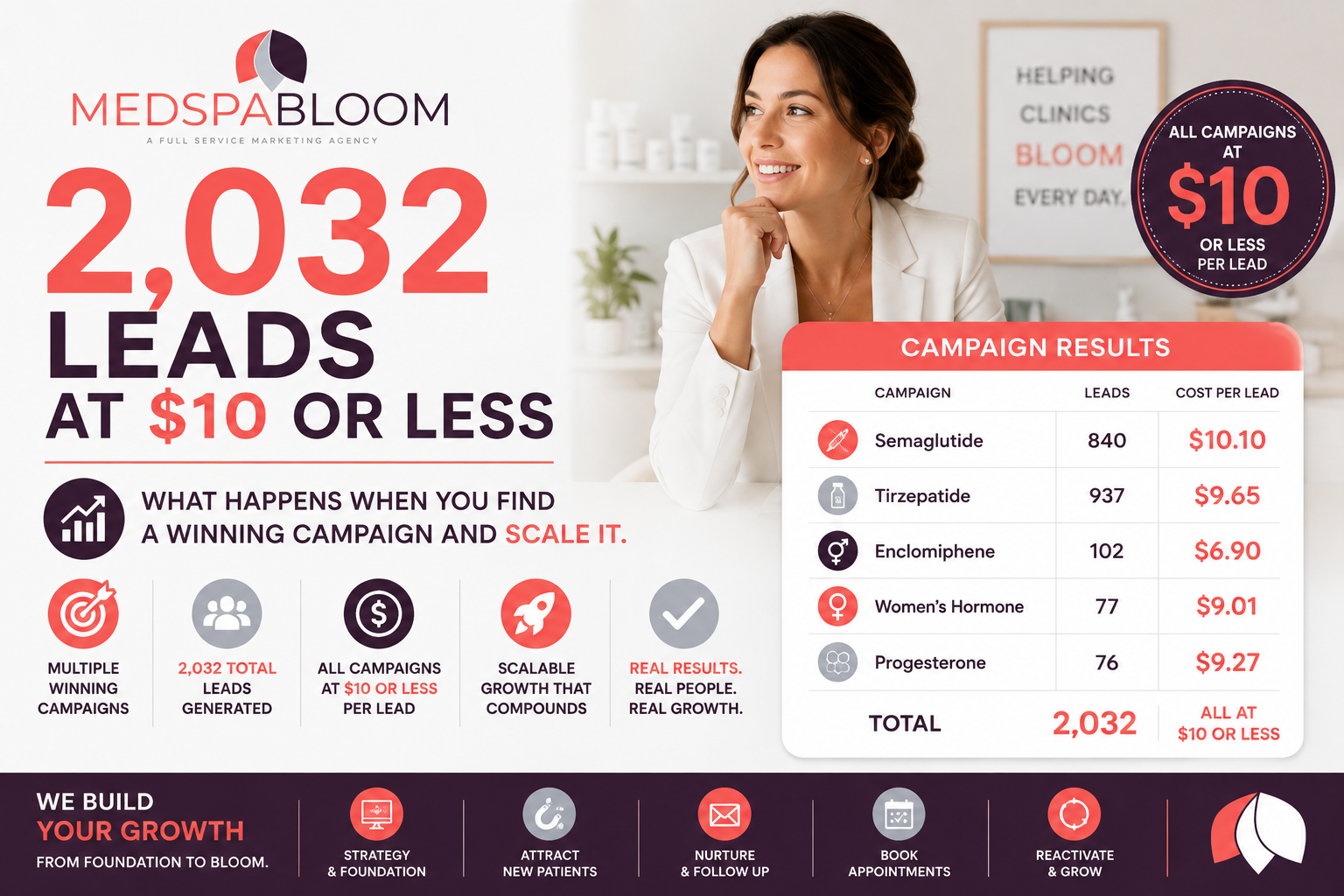
The below results are from August 2026.
Entering the medical weight loss market is still a viable option in 2026. But there’s a mistake we see clinic owners make all the time.
A campaign starts working…
…and instead of figuring out why it’s working and how far it can go, everyone starts looking for the next campaign.
New treatment.
New offer.
New creative.
New funnel.
New agency.
New “secret strategy” somebody posted about in a Facebook group.
But sometimes growth isn’t about finding something new.
Sometimes it’s about recognizing when you’ve found a winner, and scaling it without breaking it.
One Midwest health and wellness clinic we have been working with for over a year now gives us a great example.
Across five campaigns promoting medical weight loss and hormone-related services, the clinic generated:
2,032 leads.
And every campaign produced leads at approximately $10 or less per lead.
Here’s what happened and, more importantly, what other medspa, medical weight loss and wellness clinic owners can learn from it.
2,032 Leads Across Five Different Campaigns
This wasn’t one campaign that happened to have a great week.
The clinic was generating leads across five different campaigns:
| Campaign | Cost Per Lead | Leads |
|---|---|---|
| Semaglutide | $10.10 | 840 |
| Tirzepatide | $9.65 | 937 |
| Enclomiphene | $6.90 | 102 |
| Women’s Hormone | $9.01 | 77 |
| Progesterone | $9.27 | 76 |
| Total | 2,032 |
The two medical weight loss campaigns alone generated 1,777 leads.
The Tirzepatide campaign produced 937 leads at $9.65 per lead, while the Semaglutide campaign generated another 840 leads at $10.10 per lead.
That volume is important.
Because getting a handful of inexpensive leads is one thing.
Maintaining efficient lead generation while producing hundreds of leads is something entirely different.
Cheap Leads Are Easy to Celebrate. Scale Is the Bigger Story.
You’ve probably seen the screenshots.
“WE GOT $3 LEADS!”
Cool.
How many?
Four?
There’s a major difference between spending a small amount of money, finding a pocket of responsive prospects and generating a few inexpensive leads versus increasing campaign volume while maintaining reasonable acquisition costs.
As advertising scales, campaigns can encounter larger audiences, increased competition, creative fatigue and diminishing returns.
That’s why the most interesting number in this story isn’t necessarily $6.90 per lead.
It’s 2,032 leads.
The clinic found multiple campaigns capable of producing leads at attractive costs and was able to generate meaningful volume from them.
That changes the conversation from:
“Can we get leads?”
to:
“How do we turn this into a predictable patient acquisition system?”
One of the Best-Performing Campaigns Had a Very Simple Offer
There’s another lesson hiding in the numbers.
The clinic’s Enclomiphene campaign promoted a straightforward offer:
As Low As $75/Month
It generated 102 leads at $6.90 per lead.
A Progesterone campaign using a $58/month price point generated another 76 leads at $9.27 per lead.
Why does that matter?
Because clinic marketing often gets unnecessarily complicated.
A potential patient scrolling Facebook or Instagram doesn’t want to solve a puzzle to figure out what you’re offering.
They want to know:
- Is this for someone like me?
- What can it help me with?
- How much might it cost?
- What happens if I click?
Every unanswered question creates uncertainty.
And uncertainty creates friction.
Clear offers can reduce that friction by helping prospects quickly understand what is being presented and decide whether they’re interested.
Before You Blame Meta, Look at the Offer
Clinic owner reality check:
When an ad campaign isn’t performing, Meta is an extremely convenient villain.
- “Facebook leads are terrible.”
- “The algorithm changed.”
- “Meta ads don’t work for our clinic.”
- “Everyone in our area is advertising now.”
Those things can certainly affect performance, but there are other questions worth asking first.
- Is the treatment something people currently want?
- Is the offer compelling enough to make someone stop scrolling?
- Can someone understand the offer in a few seconds?
- Is the price positioned appropriately for the market?
- Does the creative make the treatment feel relevant?
- Does the landing page continue the same message?
- And what happens after the person becomes a lead?
Fix these items first.
Because spending more money on a campaign doesn’t magically make an unclear offer more compelling, it just lets more people ignore it.
The Lesson Is NOT “Everyone Should Run Weight Loss Ads”
This is an important distinction.
These results do not mean every clinic should launch Semaglutide and Tirzepatide campaigns tomorrow and expect $10 leads.
Nor does this case study establish $10 as the universal benchmark for medical weight loss leads.
In our campaign data, medical weight loss lead costs vary significantly between clinics, offers and locations. That’s normal.
- Competition varies.
- Consumer demand varies.
- Pricing varies.
- Your clinic’s reputation varies.
- The offer varies.
- The creative varies.
And what works incredibly well in one market may perform very differently somewhere else.
So don’t copy the campaign.
Copy the process.
Find out what your market responds to.
Then build from there.
Find the Winner. Then Ask How Far It Can Go.
This is where many clinics accidentally sabotage their own marketing:
- They’re constantly changing things.
- One week the offer is $99.
- Next week it’s a free consultation.
- Then it’s 20% off.
- Then someone decides the creative is getting “old,” even though it is still generating leads.
- Then the campaign gets rebuilt.
- There is absolutely a time to test.
But testing should help you find winners, not become an excuse to constantly interfere with campaigns that are already producing results.
Once you find something that works, the question becomes: “Can we scale it?“
Then ask “Can we replicate the underlying principles with another treatment?“
That’s what makes this clinic particularly interesting.
It wasn’t dependent on one campaign.
There were five different campaigns generating leads around the same attractive cost range.
That begins to create diversification instead of making growth dependent on a single promotion.
But There’s a Catch: 2,032 Leads Aren’t the Same as 2,032 Patients
This may be the most important part of the entire case study:
Leads aren’t the win. Booked appointments are the win.
And ultimately, neither lead volume nor booked appointments alone tell you whether your marketing is profitable.
A lead still has to move through the rest of your patient acquisition system.
- Lead comes in.
- Someone responds.
- The prospect engages.
- They schedule.
- They show up.
- They purchase.
- They potentially return.
If you generate inexpensive leads but nobody follows up effectively, you haven’t solved your growth problem. You’ve simply created a larger pile of leads.
That is why evaluating clinic marketing requires looking beyond the ad itself.
What Happens After the Lead Matters Just as Much
Imagine two clinics:
- Clinic A generates leads for $10 each.
- Clinic B generates leads for $25 each.
Which campaign would you rather have?
Easy. Clinic A. Right?
Not necessarily.
What if Clinic A only books 5% of its leads, while Clinic B books 25%?
Suddenly, the more expensive lead could produce significantly better economics.
This is why we want clinic owners thinking about the entire patient acquisition journey:
Ad → Lead → Follow-Up → Booking → Show → Treatment → Revenue
If you only know your cost per lead, you only know one piece of your marketing performance. A successful clinic growth strategy needs visibility into what happens throughout the process.
Scaling a Broken System Just Makes the Problem Bigger
This is also why increasing your advertising budget isn’t always the answer.
If your clinic generates 100 leads and your team struggles to contact them quickly, generating 500 leads probably isn’t going to solve the problem.
- If your nurture system is broken, more leads won’t fix it.
- If prospects are scheduling but not showing up, more bookings don’t address the leak.
- If your offer attracts the wrong patient, cheaper leads aren’t necessarily better.
Before you scale, you need to know:
- What’s working?
- What’s failing?
- Where are prospects dropping out?
- What needs to be fixed before more money goes into the system?
Otherwise, you’re not scaling growth, you’re scaling the leak.
What Medspa Owners Can Take From These 2,032 Leads
The biggest lesson from this campaign isn’t the cost per lead. It’s what happens when marketing starts becoming a system instead of a collection of random campaigns.
- Find an offer your market responds to.
- Test the message and creative.
- Measure the economics.
- Identify the winner.
- Build the follow-up and booking process around it.
- Then, when the numbers make sense, scale what is already working.
- After that, start looking for the next winner.
That’s a much different strategy than changing everything every time you have a bad week and it’s how marketing can begin moving from:
“I hope these ads work.”
to:
“We know what’s working. Now let’s grow it.”
Stop Guessing About What Your Clinic Needs
Your clinic might need more leads, but it might not. You might need:
- A stronger offer.
- Better follow-up.
- Faster response times.
- A better booking process.
- More effective nurture.
- Reactivation of the patient database you already paid to build.
Or you may already have a campaign that’s working—and haven’t realized how much opportunity there is to scale it.
That’s why MedspaBloom believes clinic growth should start by identifying what’s working, what’s failing, where the leaks are and what needs to be fixed next.
The goal isn’t simply to generate more leads. The goal is to build a marketing system that makes getting and converting new patients easier.
Want to find out what your clinic should fix or scale next?
Results vary by clinic, market, treatment, offer, budget, competition and other factors. Past campaign performance does not guarantee future results.
Share this content: